App Development
An app your customers actually use: booking, changing and arranging things themselves, without calling. Built natively, from design to the App Store.
- PlatformiPhone and iPad, native
- ProvenOur own apps in the App Store
- After deliverySource code is yours
A client reschedules an appointment in the app: the app suggests a time that fits, the client confirms and gets a notification straight away, without calling.
- Fri 15 Nov08:30
- Fri 15 Nov16:00
- Mon 18 Nov12:15
- Tue 19 Nov17:30
An app is not a business card. It has to take work off your hands.
We start with what customers arrange by phone or email today, and build the app that makes that unnecessary.
Calling about something small
Rescheduling, checking a status, changing details. Every question costs your team a phone call.
Support that grows with you
More customers now means more phone calls and email.
Customers without an overview
Appointments, documents and status are everywhere except on their phone.
How we solve it
The solution follows from the problem, not the other way round. These are the building blocks we use most often.
Native iOS apps
Built in SwiftUI, fast and familiar for iPhone users.
Self-service for customers
Booking, changing and arranging things without your team.
Connected to your systems
Calendar, CRM and backend, live in the app.
Notifications that save work
Reminders and updates at the right moment.
AI on the device
As in our own apps: smart without sending data out.
App Store and maintenance
Publishing, updates and new iOS versions taken care of.
You are not buying an app. You are buying a result.
Up front, we agree what has to improve and how we will measure it. Afterwards, we show you what it delivered.
Fewer calls and emails
Measured in support contacts per customer.More self-service
Measured in things customers arrange themselves.Satisfied users
Measured in usage and App Store ratings.Lower cost per customer
Measured in support time per customer.Outcome agreement
per processMeasure. Build. Own.
After each step, you decide whether to continue.
Measure
The efficiency audit. We map your processes, take a baseline and show you where it pays off, and where it does not.
Build
We build inside your existing systems, in short rounds your team tests itself. The work carries on as normal.
Own
You get everything in your hands. We measure what it delivers against the baseline and adjust. You can leave maintenance with us or run it yourself.
What we build is yours.
No platform you rent and no costs that grow with your usage. You get the software itself, with everything needed to understand and run it.
- Source codein your repository
- Integrations and workflowsdocumented
- Prompts and rulesreadable and editable
- Log of every actionin your own environment
- Maintenancewith us or with you
We don't just write about local AI. We ship it.
Three apps, designed and built by us. The AI model runs on the device itself. No server, no account.

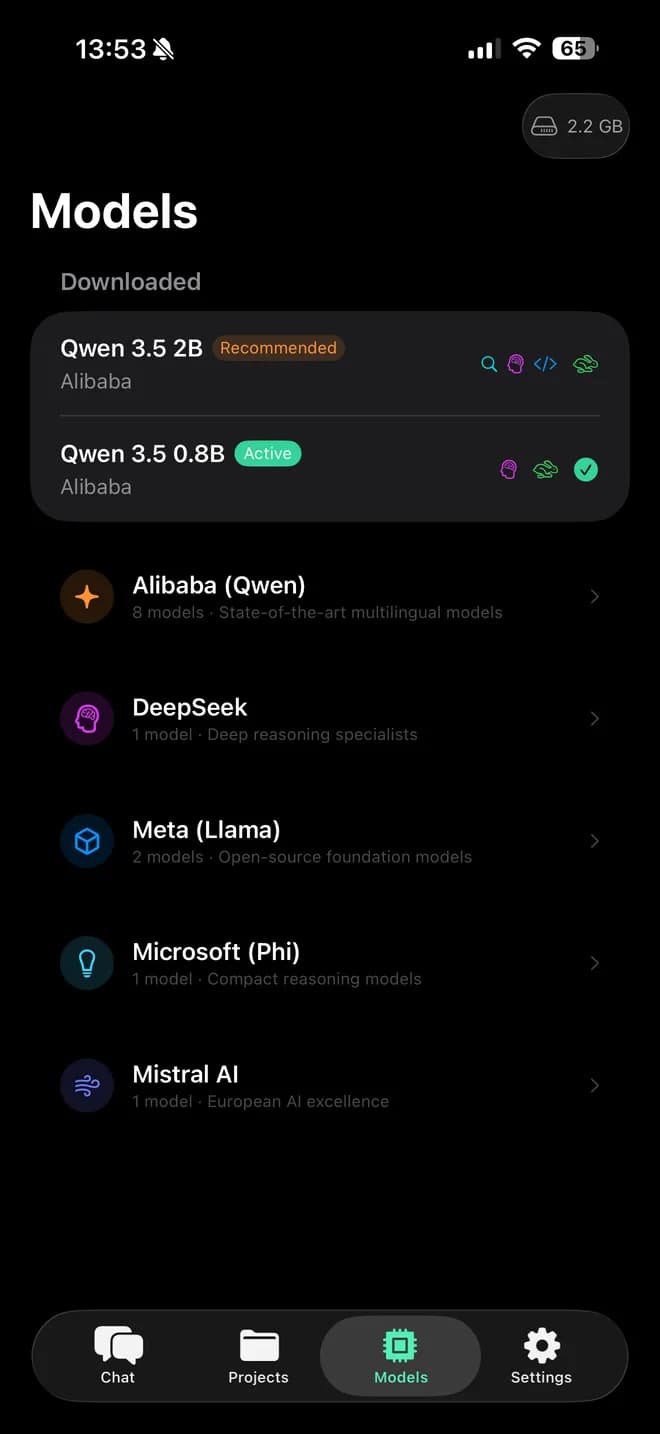
A language model in your pocket. Offline.
Chat with open-weight models from Qwen, Llama, Mistral and others, and ask questions about your own documents. Everything stays on the device.

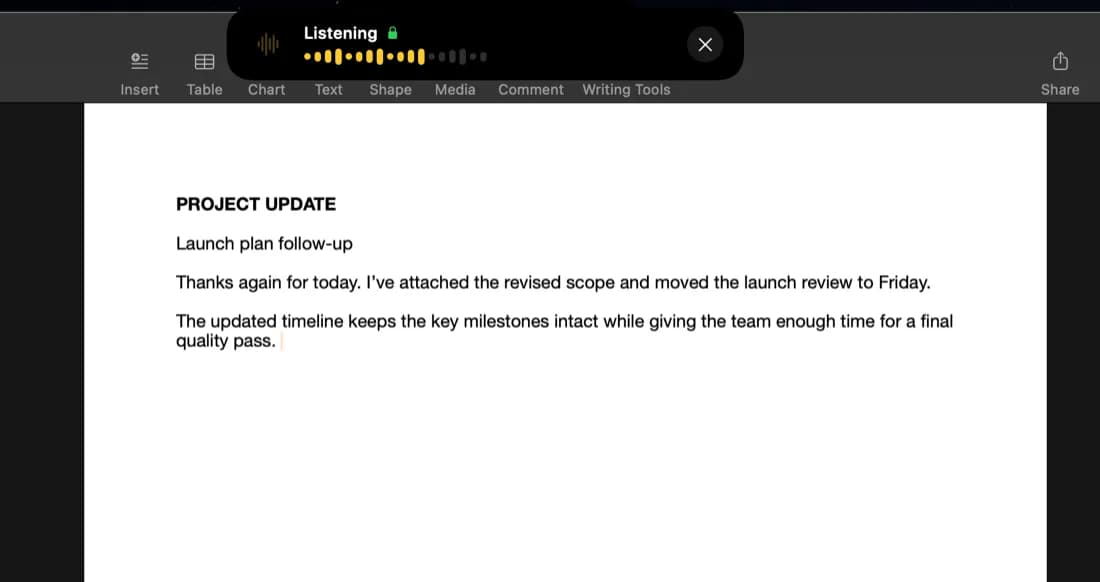
Dictate in any app. Without a network.
Speech recognition runs on the Apple Neural Engine. Dictation never connects to the internet.

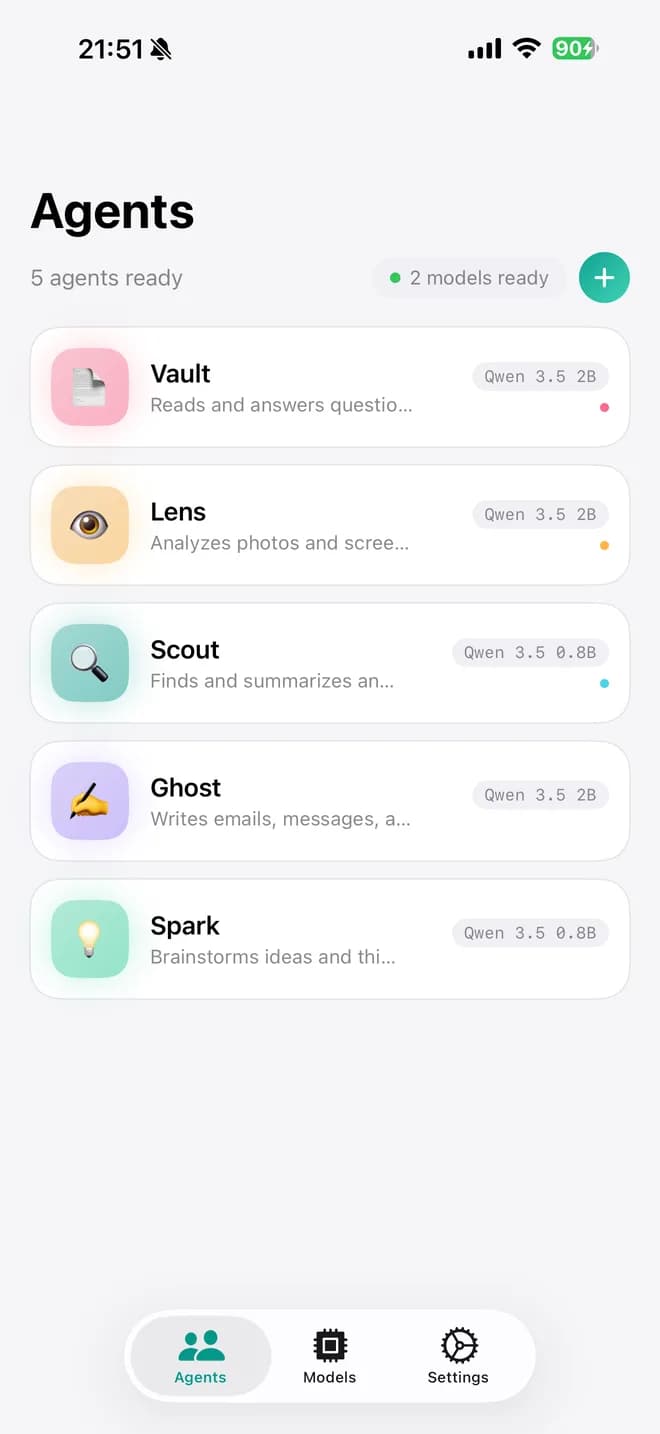
Five AI agents. One iPhone.
Agents that read documents, assess photos and write texts, each with its own local model through Apple MLX. Here Vault answers a question about a lease, and the document never leaves the device.
Choosing models, shrinking them and running them without a cloud. It is the same work we do on your servers.
Local AI for your organizationFrequently asked questions
Not seeing your question? Ask it in the audit.
The investment depends on complexity: a simple MVP costs less than a fully-featured business app with backend, which typically ranges between €15,000 and €35,000. Cross-platform apps are more expensive than iOS-only due to extra testing and QA time. We work fixed-price or per sprint, always with a detailed quote upfront so you know exactly what to expect.
A simple app (few screens, basic functionality) is live on the App Store in 4-6 weeks. An app with backend, user accounts, payments, and advanced features takes 8-12 weeks. App Store review adds an average of 1-3 days. We always plan a buffer, and you get a working build every week to track progress.
That depends on your target audience and budget. For Dutch B2B or premium B2C, we often start with iOS-only (65% of business users have an iPhone). For broad consumer markets, we build cross-platform with React Native or Flutter, giving you both platforms for 60% of the cost of two native apps. We always advise based on your customer data.
You get full access to the source code, App Store account, and backend. If you have a technical team, they can make updates independently after our handover. But most clients choose our maintenance subscription where we continue to roll out updates, bug fixes, new iOS versions, and small features, often faster and cheaper than hiring internally.
An app isn't an end product, it's a channel. We build in push notifications (average 7x higher engagement than email), make onboarding as simple as possible (deliver value within 60 seconds), and advise on in-app incentives like loyalty points or exclusive features. After launch, you get analytics dashboards showing where users drop off, so we can optimize. The best apps solve a daily frustration: that's always where we start in the concept phase.
Start with the efficiency audit.
We look together at what costs you the most. You get a baseline, an overview of where it pays off and where it does not, and a proposal for the first step.